Pyramid-Sized Asteroid Dashes Past Earth: Is It Really a Threat?

- ALIENS ARE LIKELY TO EXIST BEYOND EARTH, PROMINENT SCIENTIST ASSERTS
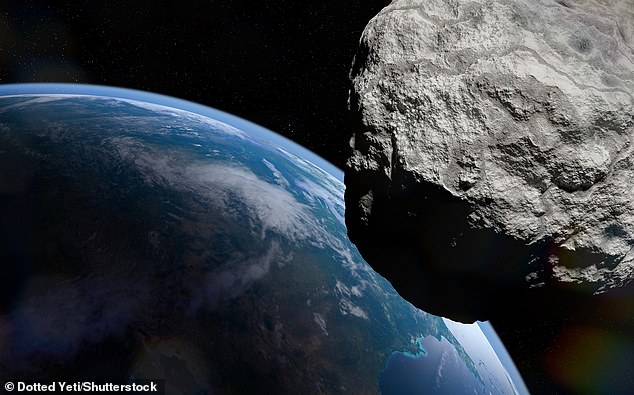
An asteroid as large as a pyramid, deemed potentially hazardous, will pass close by Earth tomorrow. NASA has revealed.
The asteroid designated as 2014 TN17 is anticipated to approach within 0.03404 astronomical units, approximately 3 million miles, of our planet at 11:34 GMT on Wednesday.
This will be the closest approach of the asteroid to Earth in over 100 years.
Asteroid 2014 TN17 is believed to have a diameter of approximately 540 feet, making it larger than the height of the Great Pyramid of Giza. Egypt (449 feet) .
It's also almost two times taller than India's iconic Taj Mahal.
When asteroid 2014 TN17 passes by Earth tomorrow, it will be moving at a velocity exceeding 48,000 miles per hour.
That's roughly 60 times the speed of sound!
Although the asteroid is categorized as ' potentially hazardous', fortunately, NASA states that this sizable space rock has absolutely no chance of colliding with Earth.
NASA includes it among those listed forthcoming near approaches on its web-based monitor , which gathers approaching celestial bodies that are progressively drawing nearer to our planet.
An asteroid is considered ' potentially hazardous' if it passes within 0.05 astronomical units (4.65 million miles) of Earth and has a size greater than 459 feet (140 meters).
Asteroid 2014 TN17 satisfies both criteria outlined by NASA, an organization continually monitoring celestial bodies with its advanced ground-based and space telescopes.
If hypothetically the asteroid 2014 TN17 were to collide with our planet, it would be substantial enough to obliterate a city, yet too small to eradicate all life from Earth.
Nevertheless, the asteroid poses no threat to Earth tomorrow.
At a distance of 3.1 million miles, it will be approximately 13 times farther from us compared to the Moon, making it impossible to observe using binoculars or telescopes.
First identified 11 years ago, the asteroid designated as 2014 TN17 follows an elliptical orbital path rather than a perfect circle. This irregular orbit causes it to complete one revolution around the Sun every 1,240 days (or approximately 3.39 years).
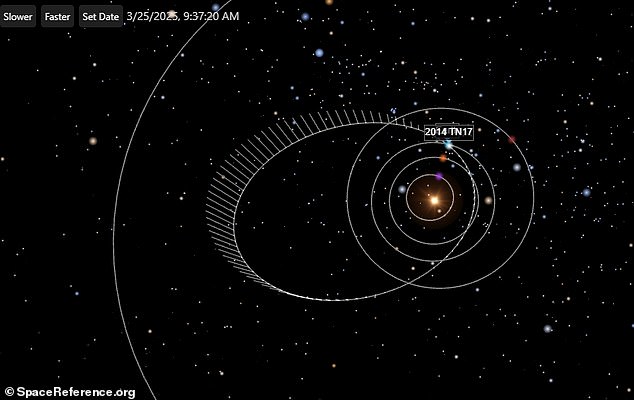
Similar to how planets, comets, and other bodies within the solar system move, asteroids circle around the Sun because of the Sun’s powerful gravitational force.
Because of its close distance to Earth, the asteroid falls under the category of a near-Earth object (NEO). This designation may apply to both comets and asteroids.
A Near-Earth Object (NEO) is classified as such when it approaches within 1.3 astronomical units (AU), which equals 120.8 million miles, from the Sun. Consequently, this brings them closer than 0.3 AU, equivalent to 27.8 million miles, to Earth’s orbital path.
NASA stated that NEOs are comets and asteroids that have had their trajectories altered by the gravitational pull of neighboring planets, causing these objects to enter orbits which bring them close to Earth.
Primarily made up of frozen water containing scattered dust particles, comets initially formed in the chilly outer region of the planetary system. In contrast, most of the rocky asteroids developed in the hotter inner part of the solar system, located between the paths of Mars and Jupiter.
The significant scientific curiosity surrounding comets and asteroids primarily stems from their role as nearly pristine remnants of the material left over from the solar system's formation approximately 4.6 billion years ago.
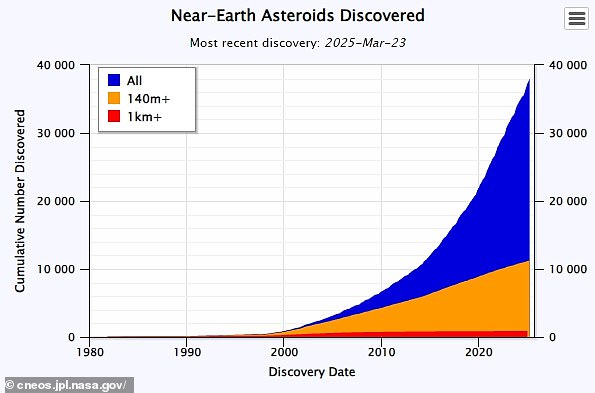
NASA estimates that approximately 11,000 Near-Earth asteroids exceed 460 feet (140 meters) in size, with about 870 of these being greater than 3,280 feet (1 kilometer) in diameter.
Typically, Earth gets struck by a rocky object about the size of a football field approximately every 5,000 years, whereas an asteroid capable of ending civilization impacts roughly once every one million years, as reported by their Near-Earth Object Program.
A recent asteroid named 2024 YR4 grabbed attention after NASA announced it might collide with Earth in December 2032.
Nevertheless, people from Earth felt relief the previous month when NASA significantly lowered the chance of an impact to approximately one in 26,000. .
If we assume that an asteroid is certainly headed towards Earth, our greatest hope might be to alter its trajectory by deliberately colliding a spacecraft with it.
NASA showed that this advanced planetary defense method is feasible when they demonstrated it in 2022. The DART spacecraft struck the asteroid Dimorphos. .
A recent study indicates that certain kinds of asteroids might be too challenging or even unfeasible to redirect using any human-made objects.
'A rubble pile' asteroid—like Itokawa, which is approximately 1.2 million miles distant—is composed of disjointed boulders and stones that have aggregated due to gravitational forces; consequently, they contain significant voids within their structure.
An asteroid like this could function as a kind of 'cushion in space,' absorbing any energy from impacts before continuing along its path, according to the study’s authors.
Read more