Hiker Discovers Ancient Ecosystem: 280-Million-Year-Old World Unveiled

- READ MORE: 80-million-year-old dinosaur eggs found in China
A 280-million-year-old hidden realm was inadvertently uncovered by a a woman during her hike in the Italian Alps .
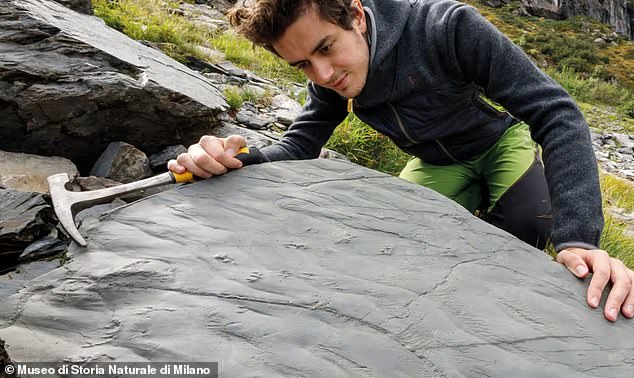
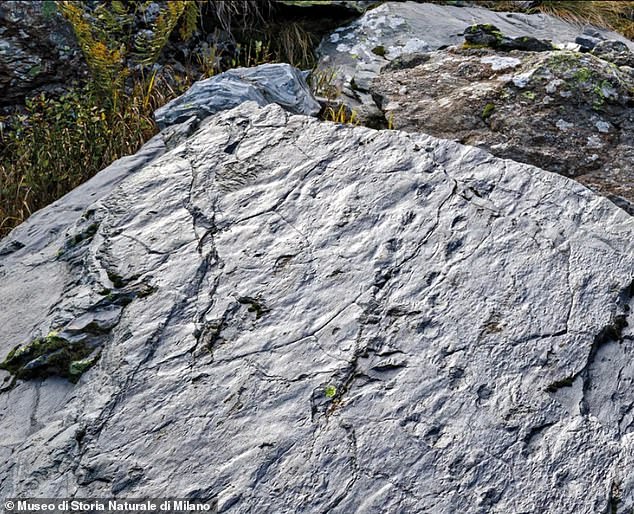
In 2023, Claudia Steffensen and her spouse were hiking through the Valtellina Orobie Mountains Park in Lombardy when she noticed a pale gray stone adorned with peculiar patterns.
As she took a nearer look, she recognized that the patterns were indeed footprints of animals.
Steffensen forwarded images to a scientific group who concluded that the tracks were from a ancient reptilian creature that traversed the planet During the Permian period, which came right before the era of dinosaurs.
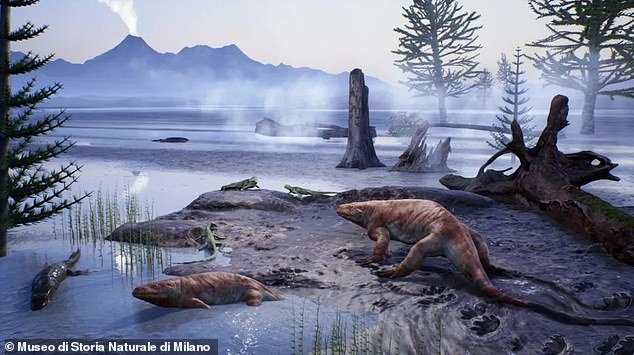
Upon further exploration of the area, paleontologists discovered hundreds of additional fossilized tracks created by at least five different species of ancient reptiles, amphibians, and insects.
Although these creatures lived before the dinosaurs, some may have reached sizes of around six to twelve feet, according to researchers' statements.
The group similarly discovered impressions of plant fossils—ranging from remnants of seeds, leaves, and stems—together with marks left by raindrops and waves upon the ancient lakeshore.
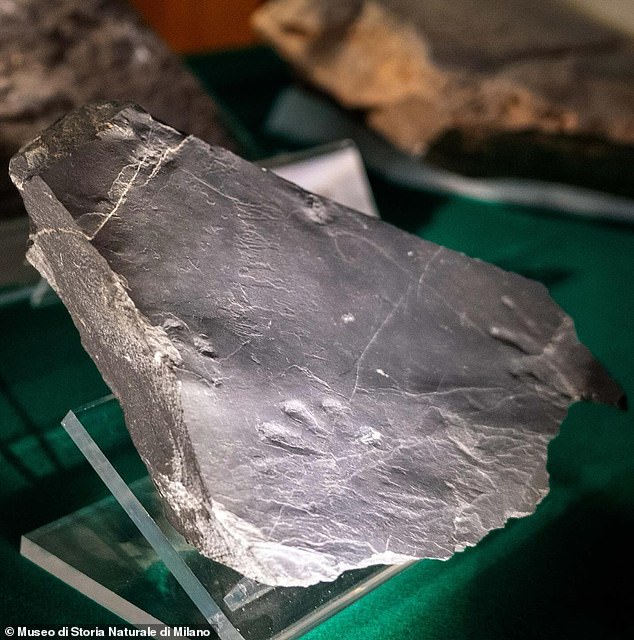
Lorenzo Marchetti, a co-researcher and specialist in trace fossils at the Museum of Natural History, Berlin mentioned that the prints were maintained with 'remarkable' clarity, including details such as 'fingernail marks and the stomach skin of certain creatures.'
The intricate details and exceptional preservation of these fossils can be attributed to their close association with water, as the researchers pointed out.
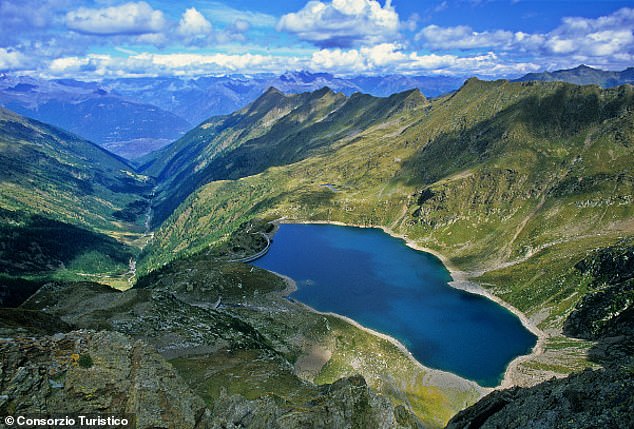
The old ecosystem, which existed at elevations up to 10,000 feet and within valley floors, has been conserved in finely layered sandstone.
Paleontologists likewise recognized claw marks and impressions left by the undersides of these creatures.
"The tracks were formed when these sandstones and shales were initially composed of wet sand and mud along the edges of rivers and lakes that would occasionally dry out depending on the season," explained co-researcher and paleontologist Ausonio Ronchi from the University of Pavia. statement .
Ronchi mentioned, 'The summer sun dried out these areas, making them so hard that when fresh water returned, it didn’t wash away the footprints; instead, they were coated with a new layer of clay, providing protection.'
The Permian epoch extended from 299 million to 252 million years ago.
Throughout this era, the worldwide climate swiftly heated up, eventually triggering a massive extinction event that concluded this epoch and wiped out 90 percent of Earth's species.
Paradoxically, contemporary global warming facilitated the unveiling of this ancient high-altitude environment, since the fossils were previously concealed beneath snowpacks that have now thawed due to the planet’s rising temperatures.
"The findings in the Ambria Valley are also a result of climate change," stated Doriano Codega, who serves as the president of the Valtellina Orobie nature park. The Guardian .
The remarkable aspect was the elevation—these artifacts were discovered at significant heights and remained remarkably intact. This region experiences frequent avalanches, which led to rock movements that exposed these fossils.
From 1850 onwards, due to human-induced climate change, Alpine glaciers have experienced a reduction of 30 to 40 percent in their surface area and about half of their total volume, with an extra loss of 10 to 20 percent occurring since 1980, as reported. Mont-Blanc Research Center for Alpine Ecosystems (CREA) .
The finding of these fossils provides insight into an old environment ravaged by severe global temperature increases. Consequently, it also acts as a warning about the potential consequences as human-induced warming approaches critical thresholds.
"These fossils ... provide evidence of a remote geologic era, yet one characterized by a warming pattern strikingly akin to what we see today," the scientists explained.
'The past holds many lessons about the risks we face as we shape the world today.'
Read more